Rename T7.1 Short-rotation croplands
The name of this ecosystem functional group in version 2.1 of the Global Ecosystem Typology is Annual croplands. However, from an ecosystem functioning perspective perennial herbaceous croplands share characteristics with annual croplands and fit best in this ecosystem functional group. We thus note the potential alternative name Herbaceous croplands, reflecting an expansion in scope to include both annual and perennial herbaceous crops.
Revision summary: Rename T7.1 Short-rotation croplands or Herbaceous/non-woody croplands
Origin: Agricultural ecosystems WG (Driver & Botts 2025)
Justification: Some intensive croplands are turned over on longer than annual cycles (e.g. biennial crops or in climates with interannually variable rainfall) but share many features with annual croplands
Current status: Proposal considered by GET-SC on 8/9/2025 and approved for public consultation on draft update
See new profile text below with changes highlighted, compare to current text at global-ecosystems.org (opens in new tab)
T7.1 Short-rotation croplands
Ecosystem properties: High-productivity croplands are maintained by intensive anthropogenic supplementation of nutrients, water, and artificial disturbance regimes (e.g. annual cultivation), translocation (e.g. sowing), and harvesting of short-lived plants. These systems are typically dominated by one or few shallow-rooted, short-lived, typically non-woody plant species such as grains (mostly C3 grasses), vegetables, ‘flowers’, legumes, or fibre species harvested destructively or renewed on cycles of less than one to a few years by humans for commercial or subsistence production of food, materials, or ornamental displays. Disequilibrium community structure and composition is maintained by translocations and/or managed reproduction of target species and usually by periodic application of herbicides and pesticides and/or culling to exclude competitors, predators, herbivores, and/or pathogens. Thus, compared to antecedent ‘natural’ systems, croplands are structurally simple, have low functional, genetic, and taxonomic diversity and no local endemism. Subsistence croplands, including Swidden rotation systems, are typically more diverse than industrial croplands. Productivity is highly sensitive to variations in resource availability. Target biota are genetically manipulated by selective breeding or molecular engineering to promote rapid growth, efficient resource capture, enhanced resource allocation to production tissues, and tolerance to harsh environmental conditions, insect predators, and diseases. Typically, at least 40% of net primary productivity is appropriated by humans. Croplands may be rotated inter-annually with livestock pastures or fallow fields (T7.2) or may be integrated into mixed cropping-livestock systems. Target biota coexists with a cosmopolitan ruderal biota (e.g. weedy plants, mice, and starlings) that exploits production landscapes opportunistically through efficient dispersal, itinerant foraging, rapid establishment, high fecundity, and rapid population turnover. Native biota from adjoining non-anthropogenic systems may also interact with croplands. When actively managed systems are abandoned or managed less intensively, these non-target biota, especially non-woody plants, become dominant and may form a steady, self-maintaining state or a transitional phase to novel ecosystems.

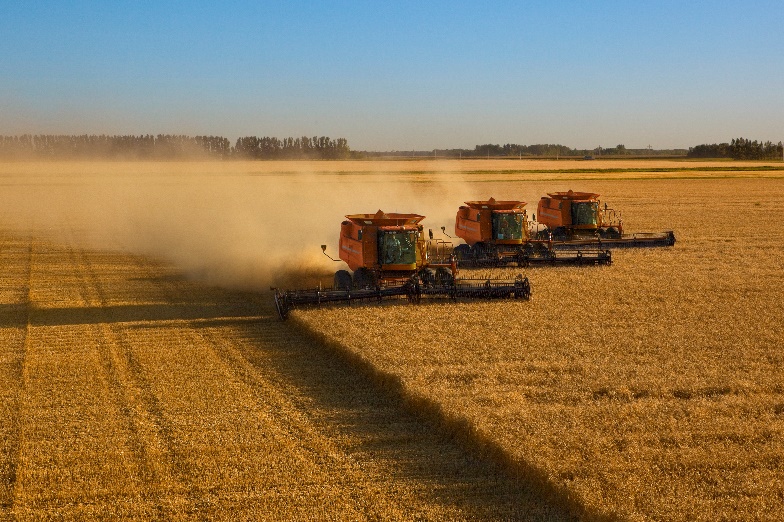
Ecological drivers: The high to moderate natural availability of water (from at least seasonally high rainfall) and nutrients (from fertile soils) is often supplemented by human inputs via irrigation, landscape drainage modifications (e.g. surface earthworks), and/or fertiliser application by humans. Intermittent flooding may occur where croplands replace palustrine wetlands. Temperatures are mild to warm, at least seasonally. These systems are typically associated with flat to moderate terrain accessible by machinery. Artificial disturbance regimes (e.g. annual ploughing) maintain soil turnover, aeration, nutrient release, and relatively low soil organic carbon content.
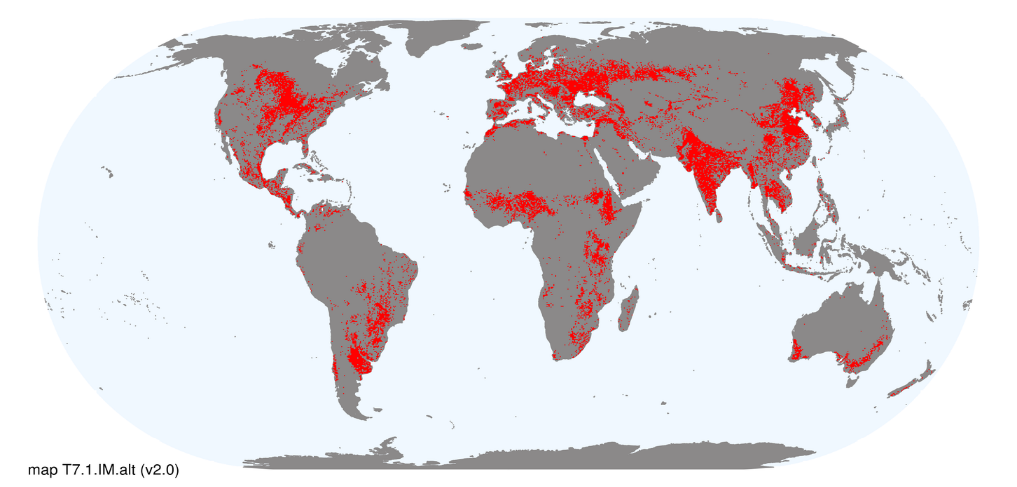
Distribution: Tropical to temperate humid climatic zones or river flats in dry climates across south sub-Saharan and North Africa, Europe, Asia, southern Australia, Oceania, and the Americas.
References
Leff B, Ramankutty N, Foley JA (2004) Geographic distribution of major crops across the world. Global Biogeochemical Cycles 18(1), GB1009.
Ray DK., Foley JA (2013) Increasing global crop harvest frequency: recent trends and future directions. Environmental Research Letters 8(4): 04404