Rename T4.4 Subhumid temperate woodlands
Revision summary: Rename T4.4 Subhumid temperate woodlands
Origin: Australian NEAP project.
Justification: Adjustment to accommodate T5.6
Proposal considered by GET-SC on 8/9/2025 and approved for public consultation on draft update
See new profile text below with changes highlighted, compare to current text at global-ecosystems.org (opens in new tab)
T4.4 Sub-humid temperate woodlands
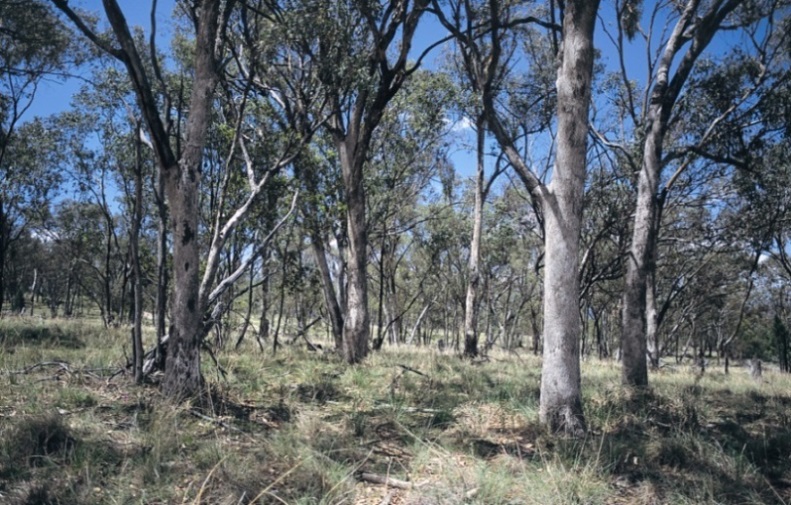
Ecosystem properties: These structurally simple woodlands are characterised by space between open tree crowns and a ground layer with tussock grasses, interstitial forbs, and a variable shrub component but generally less dense and/or less sclerophyllous than in pyric ecosystems of the Temperate forests biome (T2). Grasses with C3 and C4 photosynthetic pathways are both common but vary, with C3 grasses predominating in winter, at locally moist sites, cold sites, or areas without summer rainfall, and C4 grasses abundant under the opposite conditions. The ground flora varies with rainfall seasonally and inter-annually, with many forbs having perennial organs below ground that produce shoots when soils are moist. However, xeric traits are not strongly represented. Trees generate spatial heterogeneity in light, water, and nutrients, which underpin a diversity of microhabitats and mediate competitive interactions among plants in the ground layer. Foliage is mostly microphyll, evergreen and transmitting abundant light, or deciduous in colder climates. Plant and invertebrate diversity may therefore be relatively high at local scales, but local endemism is limited due to long-distance dispersal. Productivity is relatively high as grasses rapidly produce biomass rich in N and other nutrients after rain, sustaining a relatively complex trophic network of invertebrate and vertebrate consumers. Large herbivores and their predators are key top-down regulators. Bioturbation by fossorial mammals influences soil structure, water infiltration, and nutrient cycling. The fauna is less functionally and taxonomically diverse than in most tropical savannas (T4.1 and T4.2), but includes large and small mammals, reptiles, and a high diversity of birds and macro-invertebrates, including grasshoppers, which are major consumers of biomass. Plants and animals tolerate and persist through periodic ground fires that consume cured-grass fuels, but few have specialised traits cued to fire (cf. pyric ecosystems such as T2.6).
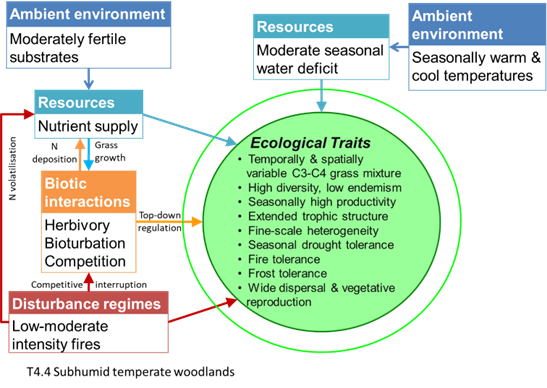
Ecological drivers: A water deficit occurs seasonally in summer, driven primarily by peak evapotranspiration in warm-hot summers and, in some regions, winter-maximum rainfall patterns. Mean annual rainfall is 350–1,000 mm, higher than in semi-arid woodlands. Low winter temperatures and occasional frost and snow may limit the growing season to 6–9 months. Soils are usually fine-textured and fertile, but N may be limiting in some areas. Fires burn mostly in the ground layers during the drier summer months at decadal intervals.
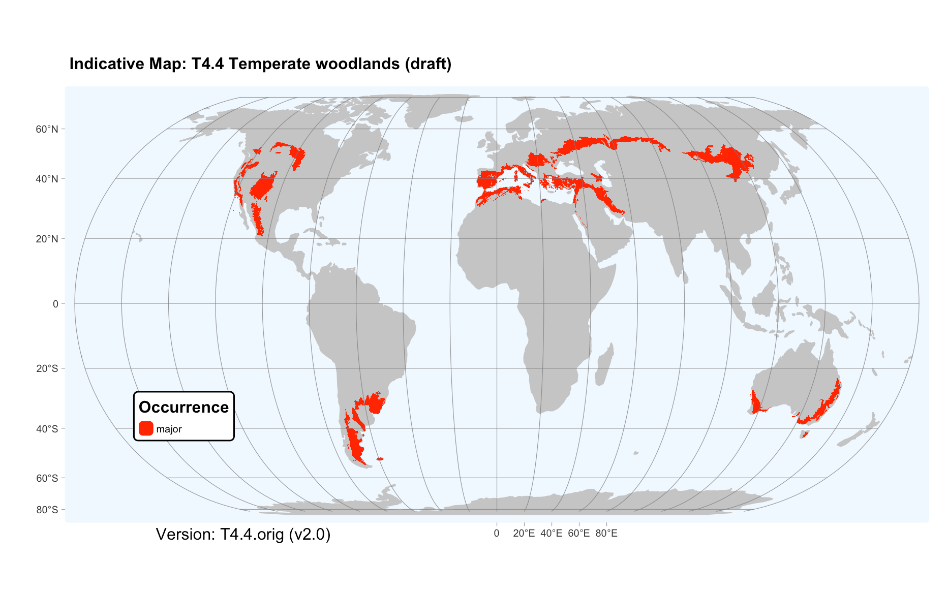
Distribution: Temperate subhumid southeast and southwest Australia, Patagonia and Pampas of South America, western and eastern North America, the Mediterranean region, and temperate Eurasia.
References:
Davis FW, Baldocchi DD, Tyler CM (2019) Oak woodlands. Ecosystems of California (Eds. HA Mooney, E Zavaleta). Chapter 25 pp 509-534. University of California Press, Berkeley.
Gibson GJ (2009) Grasses and grassland ecology Oxford University Press, Oxford.
Prober SM, Gosper CR, Gilfedder L, Harwood TD, Thiele KR, Williams KJ, Yates CJ (2017) Temperate eucalypt woodlands. Australian vegetation (Ed. DA Keith), pp 410-437. Cambridge University Press, Cambridge